

Special Educational Needs & Disabilities (SEND) Introduction
Introduction to Special Educational Needs & Disabilities (SEND)
Please note: the full report can be downloaded via the link at the bottom of the SEND Executive Summary section.
Why SEND is important?
Every child in the UK is entitled to an education with the aim for them to achieve their potential through all stages of development – early years, at school (primary and secondary) and in further education settings, and to lead happy and fulfilled lives into adulthood. However, some children have needs that mean that this may not be possible without specific help that goes beyond standard education provision. It is therefore important to identify these needs and to develop services that provide the support necessary to meet them. To achieve this, a combination of education, local authority and health services must form a local partnership to work together and importantly to work together with parents and the young people themselves.
Purpose of the Central Bedfordshire SEND JSNA
This Special Educational Needs and Disabilities (SEND) Joint Strategic Needs Assessment (JSNA) focuses on children and young adults aged 0-25 years who are residents of, or who are educated within, Central Bedfordshire. The JSNA aims to provide Central Bedfordshire SEND Partnership Board, departments with responsibility for commissioning and service delivery and local leaders with an up to date understanding of the needs of local children and young adults with SEND to:
- Inform the strategic, system wide priorities to improve independence and outcomes for children and young adults with SEND, and their families.
- Inform commissioning at both strategic and operational levels, so that services and support are tailored to need and based upon the best available evidence.
- Inform the wider system so that all relevant future plans in the local area are considered through the lens of independence and inclusion, reducing the social and environmental barriers to living with as much independence as possible.
Local offer – explaining SEND
This JSNA provides a very brief overview of some services available to SEND children and young people and their families and carers. Central Bedfordshire’s Local Offer website[1] contains information on services and support for parents or carers of children and young people with SEND across education, health and care services, voluntary agencies, leisure activities and support groups. Please see the Local Offer website for further details.
Under Section 20 of the Children and Families Act 2014 and Section 312 of the 1996 Education Act, a child or young person has special educational needs (SEN) if they have a learning difficulty or disability that calls for special educational provision to be made for them. Children have a learning difficulty or disability if they:
- Have a significantly greater difficulty in learning than the majority of others the same age.
- Have a disability that prevents or hinders them from making use of facilities of a kind generally provided for others of the same age in mainstream schools or mainstream post-16 institutions.
- Are under compulsory school age and fall within one of the definitions above or would do so if special educational provision was not made for them.
Special educational needs and disabilities (SEND) is an umbrella term that relates to a wide range of needs that can affect a child’s ability to learn in many ways, including their:
- Behaviour or ability to socialise (e.g. they struggle to make friends)
- Reading and writing
- Ability to understand things
- Concentration levels
- Physical ability
How children with SEND are supported in schools
Many children and young people will experience barriers to learning or progress at some stage in their development. This can be for a range of reasons, and for many it will require only short-term provisions or support. The Graduated Response to SEND supports children and young people to have their needs identified and met at an early stage and with support appropriate to their needs. For some children and young people, their needs may be more enduring and may require a longer or more targeted intervention to support their ongoing progress. These children are described as having a special educational need and/or disability and they may be supported through SEN support or an EHC plan.
SEN support and Education, Health, and Care (EHC) Plans
Some children require extra, or different help is given beyond that provided as part of the school’s usual curriculum. To aid this, the class teacher, and special educational needs coordinator (SENCO) will implement support in school and may request advice or support from outside specialists. Education, health, and care (EHC) plans are for children and young people aged up to 25 who need more support than is available through special educational needs support. EHC plans identify educational, health and social needs and set out the additional support to meet those needs. More details about SEND can be found on the Local Offer page or via the UK government’s Children with special educational needs and disabilities webpages[2].
SEND in Mainstream and Special Schools
The majority of children and young people with SEND are educated within mainstream schools in their local area. Mainstream schools ensure that children and young people receive support and help in line with the Graduated Response to SEND or in line with the provision outlined on their EHC Plans.
A small percentage of children require access to specialist settings or more intensive support day to day, and some of these children may be educated through Additionally Resourced Provision (ARP) or a SEND Unit in a mainstream school. Resourced provisions are places reserved at a mainstream school for pupils with a specific type of SEND, taught mainly within mainstream classes, but requiring a base and some specialist facilities around the school. Resourced provisions:
- Are designated by the local authority specifically for making this kind of SEN provision.
- Receive specialist funding from the local authority to deliver the appropriate service.
- Cater for a specific area or areas of SEN (for example specific learning difficulties)
- Are usually for pupils with an EHC plan.
SEND units are special provisions within a mainstream school where the pupils with SEN are taught mainly within separate classes. They:
- Are designated by the local authority specifically for SEN provision, and sometimes accommodate pupils registered at other schools on a part-time basis.
- Receive specialist funding from the local authority to deliver the appropriate service.
- Cater for a specific type or types of SEN (for example Autistic Spectrum Conditions).
Places in SEND Units are usually reserved for pupils with an EHC plan but may also provide support for pupils with SEN support.
Of those children or young people on an EHC plan, a small percentage will require access to a special school place to support significant and enduring needs. These are registered as specialist settings, receive specialist funding from the local authority to deliver the appropriate service and ensure that the most vulnerable children in the area can access an appropriate education designed around their needs. In 2024/25, 898 of Central Bedfordshire’s children and young people were educated in special schools, a population that has increased by 32 in the last year and from 535 pupils in 2015/16 (Source: Department for Education[3]).
Table 2: Special schools providing SEND provision in Central Bedfordshire by age, year group and specialism
| School | Age range | Year Groups | Specialism |
|---|---|---|---|
| The Chiltern School, Houghton Regis | 3 to 19 | N to 14 | Severe Learning Difficulties, Profound and Multiple Learning Difficulties and Autistic Spectrum Conditions |
| Ivel Valley School and College, Biggleswade | 3 to 19 | N to 14 | Complex Learning Needs |
| Oak Bank (Academy) School, Leighton Buzzard | 9 to 19 | 4 to 14 | Social, emotional and mental health needs with additional needs including Autistic Spectrum Disorders, Attention Deficit Hyperactivity Disorders and Speech, Language and Communication Difficulties |
| Weatherfield Academy, Dunstable | 7 to 19 | 2 to 14 | Cognition & Learning Delay, with additional needs including Autistic Spectrum Disorders, Attention Deficit Hyperactivity Disorders and Speech, Language and Communication Difficulties and/or other general Learning Difficulties |
The Central Bedfordshire Specialist School Places Plan 2022 – 2030[4] was developed following extensive public consultation and in response to rising demand following local population growth and the increasing incidence of SEND in this population. It outlines how the council will meet the increasing demand for specialist provision for EHC Plan school aged pupils (Reception to Year 14) in mainstream and special schools. The latest draft adds around 280 ARP places in mainstream schools and around 600 special school places by 2030.
The council has no legal powers to propose or determine changes to the two Academy special schools, therefore collaborative working is essential as part of a common commitment to inclusion and increasing the access to specialist places that meet the needs of all pupils. The plan identified the following pressures and gaps in provision:
- Insufficient provision to meet demand, both in ARPs and special schools, despite increases in places in recent years. Pressure for placements for pupils now exists in three primary needs: Autistic Spectrum Disorder (ASD), Cognitive & Learning, and Social, Emotional and Mental health (SEMH)
- Progression options for pupils attending an ARP are inconsistent meaning that pupils may not be able to progress with their peers – for example ASD provision in the north of the authority has primary provision in Sandy, middle school in Biggleswade, and upper school in Shefford and Stotfold.
- ARP provision is geographically uneven compared to pupil distribution – for example there is no provision in Cranfield and Ampthill and Flitwick and there is only lower/primary provision in Sandy.
- Special school accommodation has increased but still requires further capital investment. Incremental increases in pupil numbers are now more closely matched following a review of the single value top-up in 2022.
Whilst parents supported the Specialist School Places Plan proposals and principals, feedback from consultation by the council included concerns that the number of places forecasted would not be enough and therefore children would lack suitable and local provision. There were also comments identifying the need to make sure schools are funded correctly to be able to provide mainstream inclusion, as well as needing support from Special schools. In response the council committed to revising its forecasts using the latest data available to develop a longer-term plan that also ensures the right provision for the child.
To meet the forecast need, the Special School Places Plan is seeking to expand existing provision and/or create new provision using an annually reviewed and phased approach to 2030. Key to this is the ongoing transition from a three-tier to a two-tier education system across Central Bedfordshire, a shift driven by both local and national priorities. There is a clear political mandate to move to a structure more closely aligned with the rest of the country, where pupils progress from primary to secondary schools. The current three-tier system has been linked to poorer academic outcomes, with data showing that children in Central Bedfordshire often start well in early years but fall into the bottom quartile nationally by the end of Key Stage 2 and remain there through GCSEs and A-Levels. Aligning with a two-tier system is therefore seen as central to raising standards and improving long-term outcomes.
This transition is not only about educational outcomes but also about the sustainability of the school system. A higher number of small schools in the three-tier structure increases financial instability, with forecasts suggesting that over a third of local authority-maintained schools could be in deficit. At the same time, structural change creates opportunities to use existing buildings for specialist and alternative provision, early years, or community services, contributing to cost avoidance and supporting wider needs such as SEND provision.
The council has committed to an evidence-led approach. Pupil forecasts, site capacity, admissions data, and financial modelling are being combined with ongoing discussions with headteachers, academy trusts, governors, councillors, and the Department for Education. There is consideration of many factors including viability of space, transport implications, future housing growth, redundancy costs and reputational risk. The process is designed to be collaborative, with schools engaged through new School Planning Area meetings to shape the detail of transition at a local level.
SEND considerations are a central part of this transition. Moving to a two-tier model allows for earlier and more consistent identification of need, supports inclusion within mainstream schools, and provides opportunities to repurpose sites for specialist provision where required. At the same time, much of Central Bedfordshire is considered deprived in the Indices of Multiple Deprivation barriers to housing and services domain, at least in part as a result of poor public transport links and a dispersed population. Therefore, the impact on transport, access to local schools, and pathways into post-16 provision are being carefully assessed to ensure children with SEND are not disadvantaged.
The council recognises that this is a complex and sensitive change, and that trust with schools and families must be rebuilt through open communication and transparency. By taking a phased and evidence-based approach, the goal is to deliver a more coherent, financially viable, and inclusive education system that improves outcomes for all children.
Parent and carer views
Members of the SNAP Parent and Carer Forum represent the views of parent carers of children with SEND aged 0-25 years living in Central Bedfordshire and work in partnership with health, education and social care services and support towards raising standards and sharing knowledge and experience. In August 2024 SNAP published their latest Test the Temperature[5] survey report, informed by 297 local parent carers, to monitor progress in parent carer experience of the EHC Plan process. The survey reports an overall and continuing decline in the satisfaction levels of parent carers with the EHC Plan process and in their communication with the EHC Team over the four years the survey has been conducted. Though there were some positive comments about this process and improvements to local authority services (including increased completion rates for EHC Plans within 20-week statutory timescales), reasons for concern, anger and frustration amongst parent carers included:
- The EHC Plan process is slower than it should be and plans can be poorly written.
- Communications with the EHC Team can be poor, particularly the need to chase for updates, the slowness and poor quality of responses and lack of continuity (e.g. handovers) when staff change
- Many parent carers don’t feel listened to and lack the support needed.
- The Annual Review process was of a poor quality, some felt it was rushed with mistakes made, a lack of coproduction and timelines missed, though school involvement in the process was singled out by some for praise.
- Widespread concerns about the EHC Plan audit process, its development and its ability to improve EHC Plans for children and young people. SNAP are working with Central Bedfordshire Council and others to improve this.
- Long waiting times for Bedfordshire Community Health Services, particularly Community Paediatrics and Speech and Language Therapy.
- Waiting times for autism assessment by Bedfordshire and Luton Child and Adolescent Mental Health Services of around 20 months (up from an average of 12 months in July 2023).
A workshop on improving communications and building positive and sustainable relationships with parent carers was held in 2023 with senior managers from Central Bedfordshire Council, the BMLK NHS Integrated Care Board and local health providers. In response SNAP PCF asked that the following 6Cs in Figure 1 below be adopted as a new way for all to work together to improve SEND services. The latest (Summer 2024) Test the Temperature survey report also recommends the following:
- That recommendations from the 2022 and 2023 surveys are started and/or completed.
- That case studies from complaints are used to inform the development of social care practice in a similar way that SNAP PCF have worked with social care teams in workshops to gain insight into the impact negative experiences on parents and working together to improve practice.
- To review the Key Performance Indicators (KPIs) for the EHC Plan team, particularly how the focus on ensuring EHCPs are completed within the statutory 20 weeks is impacting the quality of the plans and the communication with parent carers.
- That new staff interviews focus on employing people who are child-centred, can be empathetic with parent carers and have the right technical knowledge. If the 6C’s were part of the interview process, this could help to support this.
Lastly, SNAP PCF comment that if only one recommendation from their previous report could be prioritised, it would be to create a problem-solving task and finish group to review the survey feedback to find solutions and implement them.
Figure 1: Improving SEND services through shared values and culture change: SNAP PCF 6Cs approach for local Health providers
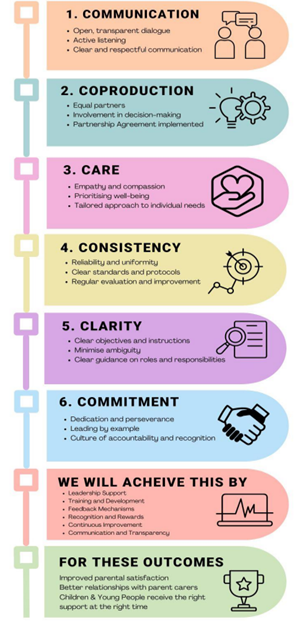
Source: Summer 2024 Test the Temperature Survey Report[6]
References
[1] Central Bedfordshire SEND Local Offer (accessed 17/10/2025)
[2] Children with special educational needs and disabilities (SEND): Overview – GOV.UK (Accessed 17/10/2025)
[3] Special Educational Needs in England data for Central Bedfordshire, accessed 15/09/2025
[4] 11.2 Appendix A Specialist School Place Plan.pdf (Revised version October 2023, accessed 17/10/2025)
[5] Via SURVEY UPDATES – SNAP PCF – Central Bedfordshire (Accessed 17/10/2025)
[6] SURVEY UPDATES – SNAP PCF – Central Bedfordshire (Accessed 17/10/2025)